
Characters in Rutherford's life
-
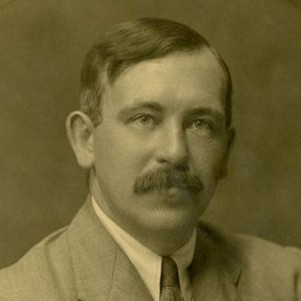
Ralph Fowler, Date unknown, source : Royal Society
-
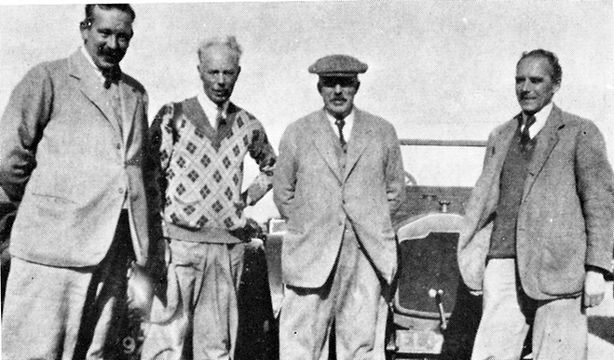
Golf Party - Ralph Fowler, F.W. Aston, Rutherford, G.I. Taylor. Source : AIP
-
Eileen Rutherford and Ralph Fowler
-
Solvay Congress of 1927 in Brussels. Ralph Fowler is in the last row on the right
-
Ernest Rutherford and Peter Fowler, his first grandchild
-
Ralph Fowler & Ernest Rutherford, with the Fowler children and friends of theirs, summer 1931
Ralph Fowler
(1889-1944)
A mathematician, physicist, and astronomer, Ralph Howard Fowler provided invaluable assistance to Ernest Rutherford, thanks to his mathematical skills and his understanding of new theories, such as quantum physics and relativity.
Quite comparable to Rutherford in temperament and physique, Ralph Fowler quickly became indispensable to the boss of the Cavendish laboratory.
Indeed, upon his arrival in Cambridge in 1919, Ernest Rutherford called on the expertise of Ralph Fowler for the most complex calculations linked to his work on the nucleus of the atom. But they also got along very well and, outside the laboratory, they quickly found a common passion: golf.
Fowler was indeed an accomplished sportsman, also distinguishing himself in tennis.
Nevertheless, a key difference remained between the two men, aside from their 18-year age gap: Ralph had been drafted, whereas Ernest had not; Ernest had contributed to the war effort through defense-related research, but behind the lines.
As an artillery officer in the Royal Naval Artillery, Ralph Fowler had fought in the Battle of Gallipoli in 1915. He was wounded in the shoulder and back and lost half a lung. That said, without those injuries, he likely would not have forged the connections he developed after the war with Rutherford and his team.
He spent his convalescence in Cambridge, and it was there that he was contacted in 1916 by a physiologist named Archibald Hill, a member—like Fowler and Rutherford—of Trinity College and equally gifted in mathematics and the life sciences. A captain in the Cambridgeshire Regiment, Hill had himself been approached a few months earlier, while on leave, by a man named Horace Darwin, acting on behalf of the Ministry of Munitions. The founder and director of the Cambridge Scientific Instrument Company, this Darwin—the ninth of naturalist Charles Darwin’s ten children and, as such, the uncle of Charles Galton Darwin, Rutherford’s collaborator—manufactured equipment for the university as well as for government departments that, prior to 1914, had sourced their supplies from German manufacturers.
At first, Archibald Hill was supposed to simply offer some advice on training anti-aircraft gunners—a one-day assignment, nothing more, as Horace Darwin had told him. But Hill embarked on an in-depth study of the best method for locating the targets of these gunners and eventually devised a double-mirror system for estimating the altitude of airplanes. As a result, he was hired by the Ministry of Munitions, which then established an experimental anti-aircraft unit, of which he was named director. As for the team he assembled, it consisted of researchers who were either too old or too young to be sent into combat, or of soldiers who had returned wounded, such as Ralph Fowler. Fowler, in fact, served as deputy director—a role made all the more necessary as “Hill’s Brigands,” as they were soon dubbed, rapidly grew to a staff of one hundred. In practice, Fowler was responsible for the practical implementation of the ideas that sprang from Archibald Hill’s mind.
In addition to improving the mirror system invented by A.V. Hill, their areas of study included the aerodynamics of shells and sirens, as well as the harmonics and pure tones produced by some of them.
This experience allowed Ralph Fowler to develop skills in experimental physics, even though he had initially focused solely on mathematical theory. As a result, he was able to maintain a close professional relationship with Ernest Rutherford (to the point that Rutherford set up an office for him in the room next to his personal laboratory).


In June 1921, Ralph became engaged to Eileen, the daughter of Ernest and May Rutherford, who was 12 years his junior. They were married on December 6 of that same year in the chapel at Trinity College, Cambridge.
They had four children:
-
Peter Howard Fowler (1923-1996)
-
Elizabeth Rutherford Fowler (1925-2021)
-
Eliot Patrick Fowler (1927-2021)
-
Ruth Eileen Fowler (1930-2013)
In 1927, Ralph Fowler attended the 5th Solvay Physics Congress in Brussels, which focused on quantum mechanics, along with Albert Einstein, Marie Curie, Paul Langevin, Hendrik Lorentz, Lawrence Bragg and many more. For the first time, Ernest Rutherford did not attend.

In December 1930, about ten days after the birth of their fourth child, Eileen died suddenly, at only 29.
Ralph then lived with another couple, the Cooks, with whom he and Eileen had already shared a house a few years earlier, in a suburb of Cambridge.
In their misfortune, the four Fowler children were lucky enough to have a second mother, in the person of Phyllida Cook.
Ralph, in fragile health, did not live very long, dying in 1944, at 55.

Sources :
-
The collected papers of Lord Rutherford of Nelson, volume I, face à la page 832
-
Fowler Ralph - obituary notice, by E. A. Milne, Nature, 1944
-
SIR RALPH HOWARD FOWLER, 1889-1944: A CENTENARY LECTURE by SIR WILLIAM McCREA, F.R.S. Astronomy Centre, University of Sussex, Brighton